Six research projects on coastal and marine questions—focusing on salt marshes, microscopic sea creatures, shellfish and seaweed aquaculture, coastal flooding and public willingness to invest in state park resilience projects—have been selected for funding by Connecticut Sea Grant.
The two-year projects, slated to begin this year, are being funded with almost $900,000 in federal funds administered by CT Sea Grant. The addition of matching funds will bring the entire research investment to $1.37 million.
“This funding cycle marks the first time CT Sea Grant has issued an exploratory research call which is aimed at enabling investigators to pilot smaller, risky or innovative ideas and projects,” said Syma Ebbin, CT Sea Grant research coordinator. “The selected projects include a mix of established and early career researchers, disciplinary perspectives and Connecticut institutions, all aimed at enhancing our understandings and promoting a healthy Long Island Sound environment.”
The projects were chosen from 14 proposals after an independent peer review process. The projects are:
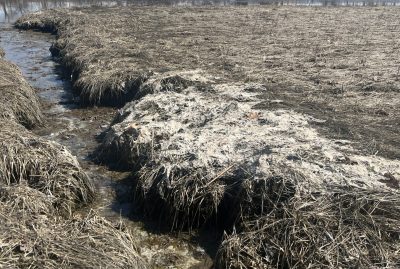
- Investigating whether manual removal of wrack—the seaweed, marsh grasses, shells, trash and other matter that collects along the shoreline—is an effective means of enhancing the speed and sustained recovery of restored salt marshes. The project is led by Nicole Spiller, director of the Earthplace Harbor Watch program in Westport, and Sarah Crosby, director of conservation and policy at The Maritime Aquarium at Norwalk.
- testing specimens of the zooplankton Acartia tonsa, which have adapted to elevated temperatures to determine how they respond to combined ocean warming and low oxygen events. The research is led by UConn Marine Sciences Professor Hans Dam.
- mapping the movement and deposition of sediments flowing from the Connecticut River into Long Island Sound, and examining how this impacts shellfish beds, to inform aquaculture management and restoration planning. The work is led by Elizabeth Weidner and Shuwen Tan, both professors in the UConn Marine Sciences Department.
- developing a method that uses artificial intelligence and spectroscopy to monitor sugar levels in cultivated kelp to determine the optimal time to harvest the crop for maximum quality and yield. Leading the project is Yu Lei, professor in the UConn Department of Chemical and Biomolecular Engineering, partnering with Jonathan McGee, owner of New England Sea Farms in Guilford.
- surveying visitors to four Connecticut coastal state parks about their willingness to pay into a fund to support projects such as living shorelines, beach nourishment and relocation of park buildings in response to coastal inundation and to maintain public access. The lead researchers are Economics Professor William Vasquez Mazariegos and Physics Professor Robert Nazarian, both of Fairfield University; and Economics Professor Jennifer Trudeau-Tham of Sacred Heart University.
- developing a dataset to elucidate flooding frequencies in coastal New England communities and associated impacts on stormwater collection systems to help municipal engineers and planners identify at-risk areas and facilitate the ability of communities to acquire funds to improve infrastructure. UConn Professor James Knighton of the Department of Natural Resources and the Environment leads the project.
“This represents a range of topics, from high tech for medium-term applications to very applied and immediately applicable projects, all with the potential to improve Long Island Sound and its coastal communities,” added Connecticut Sea Grant Director Sylvain De Guise.
More information: Judy Benson, CT Sea Grant communications coordinator: judy.benson@uconn.edu; (860) 287-6426